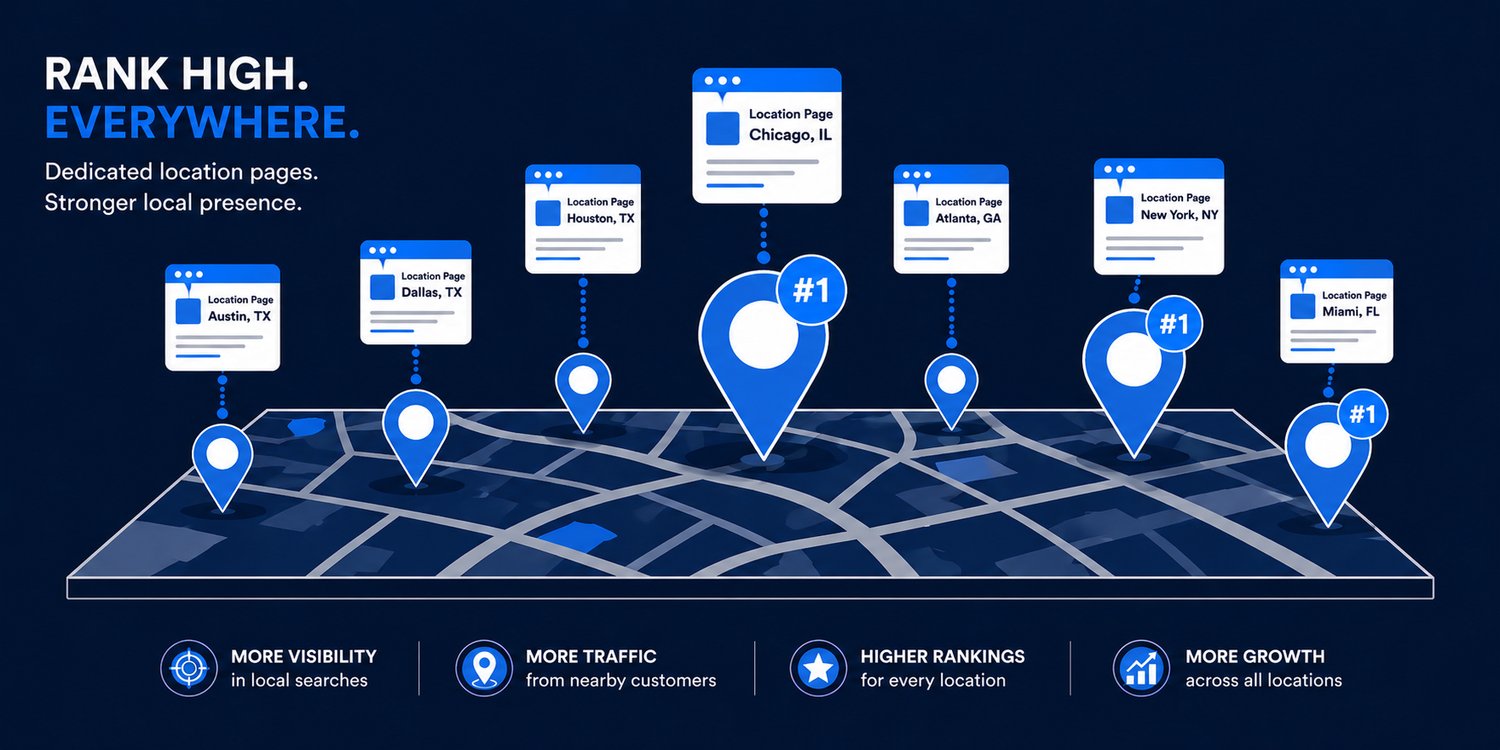
Serving a wider region does not automatically mean every city needs its own page. A generic service-area sentence may be too broad to help a customer understand where you work, but a large set of near-identical city pages is not a better answer. The useful middle ground is a location-page strategy built around real markets, clear customer needs, and pages that have something worthwhile to say.
What Makes a Location Page Worth Creating?
A dedicated location page should have an independent reason to exist. That may be real work in the market, a customer review, a project gallery, or a clear business opportunity where customers genuinely need a more specific page. It should help a visitor understand whether the business is a fit, not just repeat a service name beside a different city.
For example, a business that has completed projects in a community can show that work truthfully. A business that wants to grow in a nearby market may still create a useful page when the market is strategically important and the page can answer buyer questions without pretending the company has an office or a long history there.
Proof-Led Pages Start With Real Local Evidence
The strongest location pages are proof-led. They can point to genuine local clients, completed projects, reviews, or other documented experience. That evidence gives the page a natural story and gives a prospective customer a reason to trust that the business understands the market.
Proof needs to be specific and accurate. Do not manufacture a local testimonial, imply a project happened somewhere it did not, or present a service-area mention as proof of an office. A real project or review is valuable precisely because it does not need embellishment.
Opportunity-Led Pages Can Still Be Useful
An existing local client is not the only reason to target a city. An opportunity-led page can make sense when the business genuinely serves and wants work in the market, the search opportunity is worth pursuing, and the page can provide independent value. That page might explain the service fit, the process, relevant regional work, and what a customer can expect.
Regional proof can support an opportunity-led page when it is labeled honestly. It should never be presented as a local project, local office, or local review when it is not.
Why City-by-Service Multiplication Is Not a Strategy
Creating every possible city and service combination usually produces pages with little to say. Swapping city names in the same copy does not create a better customer experience, and it can make a site look less trustworthy. A page should be created because it adds useful information, not because a spreadsheet has another empty row.
Start with the markets that have the clearest proof or opportunity. Then decide whether a dedicated page can offer something distinct before expanding further.
Internal Links Should Reflect Real Relationships
Location pages work best when they are part of a clear site structure. A regional hub can introduce the overall service area, individual pages can link back to that hub, and relevant service, project, or portfolio pages can support the relationship where they genuinely help a visitor.
Union Web Designs uses this approach on its Central Ohio web design hub, where visitors can explore the markets currently in focus without wading through a long list of mechanically generated pages.
Build Coverage That Visitors Can Trust
The goal is not to make the largest possible collection of location pages. It is to create clear, honest pages for markets that matter to the business and to the people searching there. When each page is supported by real proof or a genuine opportunity, the site becomes more useful for customers and more coherent for search engines.
If you are deciding which markets deserve attention, start with where you already work, where you want to grow, and what useful information you can provide without inventing local facts.