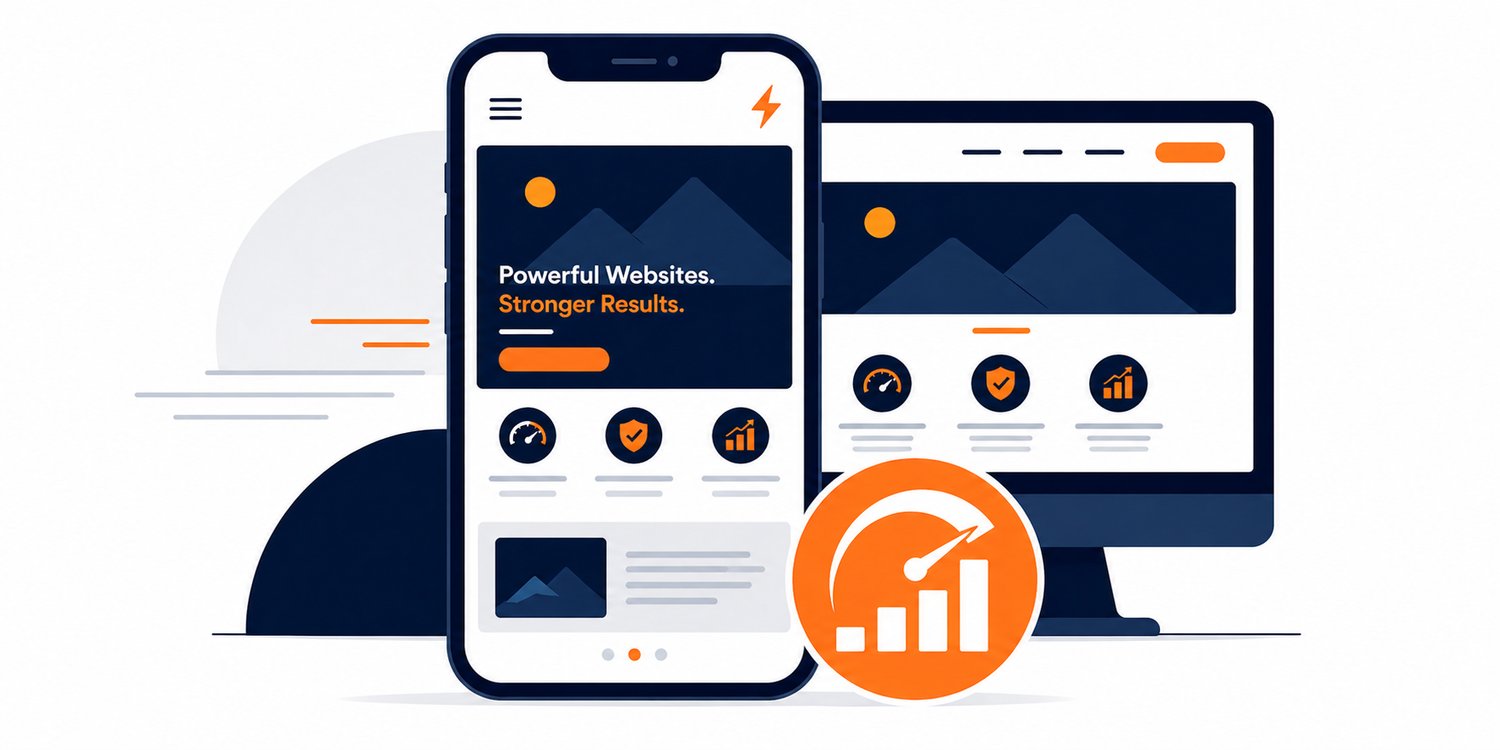
Picture a homeowner in Hilliard standing in their backyard, watching their AC unit making a sound it shouldn't. They pull out their phone and search "AC repair Hilliard Ohio." In the next fifteen seconds, they will tap a result, scan a website, and either call the number they see or hit the back button. That entire decision happens on a four-inch screen in about the time it takes to read this paragraph. Is your website built for that moment?
1. Google Indexes the Mobile Version of Your Site First
Since 2023, Google uses mobile-first indexing, meaning it evaluates your site based on how it performs on a smartphone, not a desktop. If your mobile experience is slow or broken, your rankings suffer across all devices. A hand-coded site built with mobile-first principles from the ground up performs differently than a desktop template that was squeezed into a smaller screen after the fact.
2. Load Time on Mobile Data Is a Different Problem Than Desktop Wi-Fi
A site that loads in 1.5 seconds on a home fiber connection might take 4 seconds on an LTE network in a rural pocket outside Delaware or Marysville. Those extra seconds are not just a minor inconvenience, they are the difference between a call and a competitor's call. Optimized images, minimal render-blocking scripts, and lean custom code are the tools that solve this specifically on mobile networks.
3. Your Call-to-Action Needs to Be Thumb-Friendly
A potential customer in Powell isn't going to hunt for your phone number. It needs to be visible without scrolling, formatted as a tap-to-call link, and large enough to tap without zooming. The same goes for contact forms, three fields maximum on mobile. Name, phone, message. That's it. Every additional field is friction that costs you a lead.
4. Local Service Searches Skew Even More Heavily Mobile
General web browsing splits more evenly between desktop and mobile. But "emergency plumber Dublin Ohio" at 9pm on a Tuesday? That search is happening on a phone. The higher the urgency of the service, the higher the likelihood the customer is on a mobile device. Service businesses in Central Ohio need to treat mobile optimization as a conversion tool, not just an aesthetic consideration.
Built for the Screen Your Customer Is Actually Using
A mobile-first design approach isn't about shrinking your desktop site. It's about designing for the smallest screen first, getting the most critical information, actions, and trust signals in front of a customer immediately, and then expanding that experience for larger screens. It's a fundamentally different discipline, and one that custom web design does far better than any drag-and-drop builder.
If you're not sure how your site performs on mobile, run it through Google PageSpeed Insights on the mobile tab. Then look beyond the score at the issues affecting speed, layout stability, and usability for real visitors.