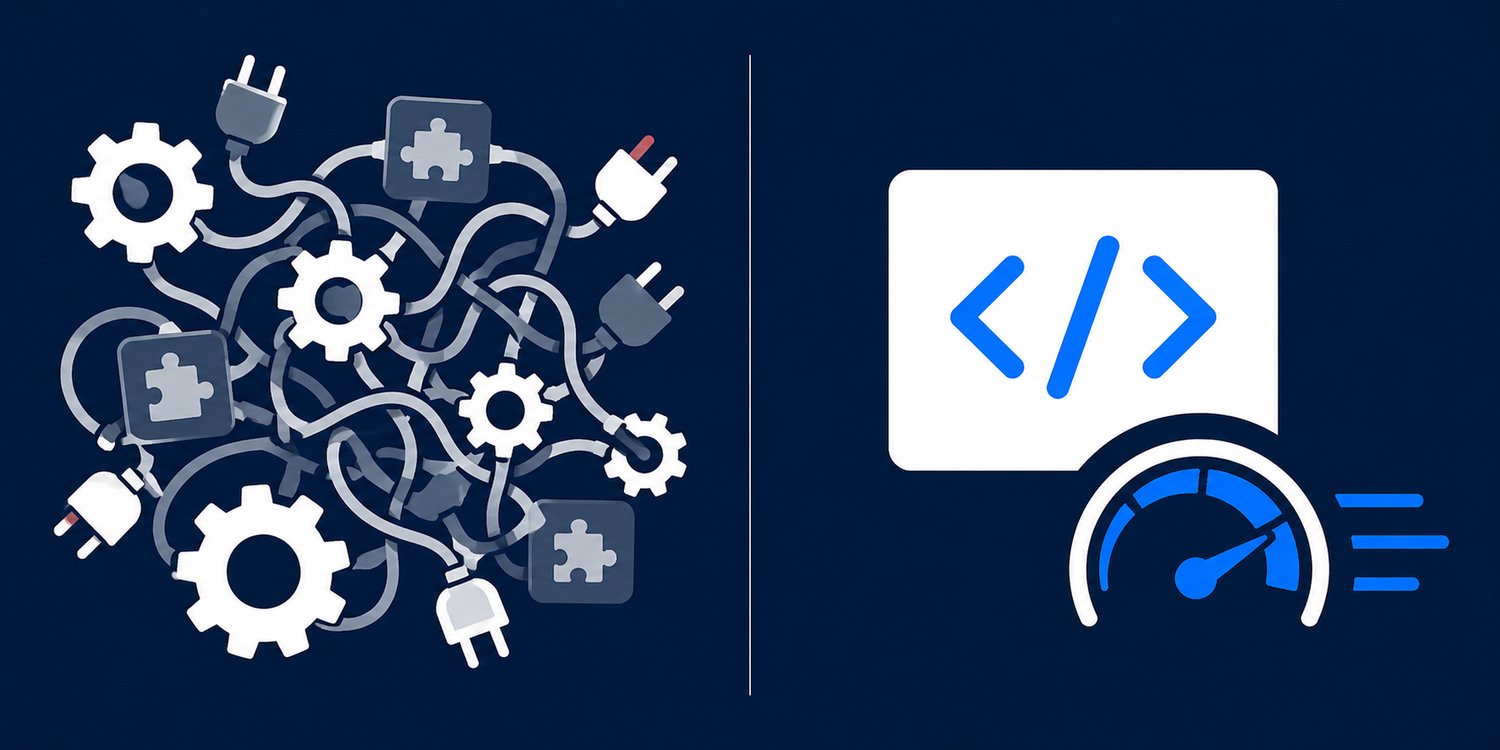
When a contractor in Dublin asks whether they need WordPress or a custom-coded website, the honest answer is: it depends on what you're trying to accomplish. WordPress powers about 40% of the web, so it's clearly capable, but capable and right for your situation aren't the same thing. Here's what the comparison actually looks like for a service business trying to rank locally and convert leads.
1. WordPress: Flexible but Fragile Under the Hood
WordPress is a content management system originally built for blogging. Its strength is flexibility, thousands of plugins for every function imaginable. Its weakness is that every plugin adds weight, and weight kills performance. A WordPress site with a page builder, SEO plugin, caching plugin, form plugin, and slider can easily load in four to six seconds on mobile. For local service searches in Hilliard or Powell, that load time means a significant portion of visitors bounce before the page finishes rendering.
2. Custom-Coded Sites Start Where WordPress Has to Work to Get
A hand-coded website doesn't use a CMS framework, theme, or plugin ecosystem. It's built from scratch with only the code the site actually needs. The result is a leaner file that loads faster, renders more cleanly on mobile, and requires no plugin updates to maintain security. On Google PageSpeed Insights, a well-built custom site routinely scores in the 95–100 range on both mobile and desktop, a benchmark most WordPress sites struggle to sustain without significant optimization work layered on top.
3. The Security and Maintenance Gap
WordPress sites require ongoing maintenance: core updates, theme updates, plugin updates, database backups, and security hardening. Skip any of these and you open the door to malware injections, database exploits, and sudden outages. Custom-coded sites have no CMS to update, no plugin vulnerabilities to patch, and no third-party dependencies that can break on a bad update day. For a contractor running jobs across Central Ohio, website downtime during peak season isn't just inconvenient, it's missed revenue.
4. What WordPress Does Better
WordPress wins on two fronts: initial cost for DIY builds and editorial ease for content-heavy publishing. If you're publishing dozens of articles per week or need a large team of editors, a CMS makes content management practical. For most local service businesses, a handful of service pages, a blog, a contact form, that editorial infrastructure is overkill, and you're paying a performance penalty for features you'll never use.
5. The Question Worth Asking
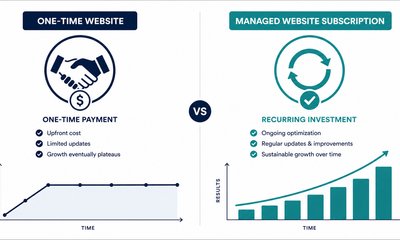
Before choosing a platform, ask what problem you're actually trying to solve. If the goal is more calls from local search, performance and SEO structure matter more than the publishing dashboard. Most Central Ohio contractors in the trades, HVAC, roofing, plumbing, landscaping, are trying to rank locally, load fast, and convert visitors. A custom-coded site, especially on a managed subscription, is built specifically for that outcome.
The Tool Should Match the Job
A hammer and a drill are both legitimate tools. Neither is better in the abstract, it depends on what you're building. WordPress is a powerful tool used in the wrong context for most service businesses. A custom-coded site is designed around the exact problem most contractors are trying to solve: fast, local, and converting.
If you're weighing your options or inherited a WordPress site that's underperforming, review the custom web-design services available, then let's run a quick audit together and look at the numbers side by side.